African Country Flags: A Complete Visual Guide
July 5, 2026
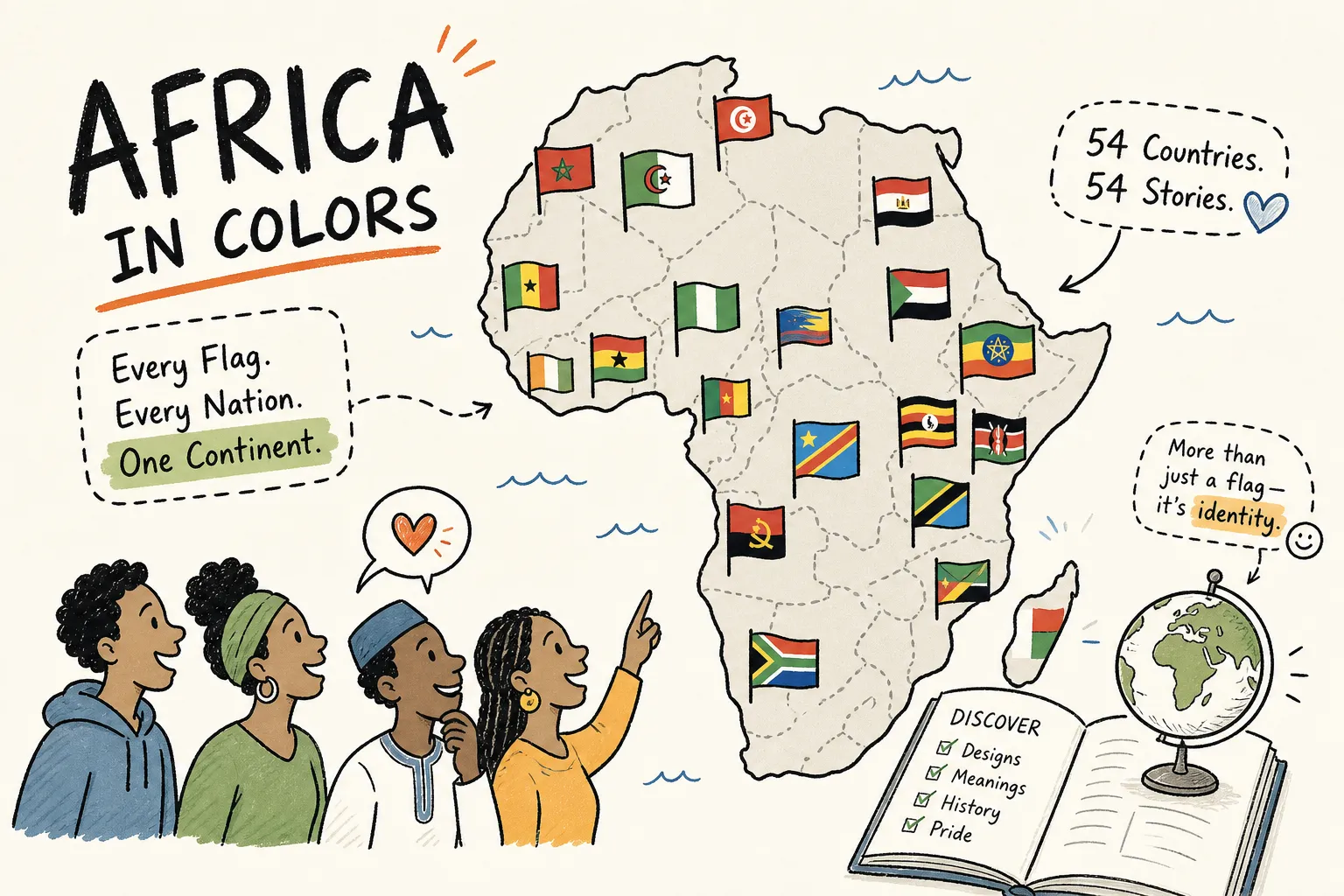
Africa has 54 countries and 54 national flags, yet most people can confidently identify fewer than ten. That gap isn’t a failure of memory — it’s a failure of context. Once you understand three core color traditions and four regional design patterns, those 54 flags stop feeling like a chaotic wall of colors and start reading like a visual language with its own grammar.
This guide walks through color symbolism, regional groupings, recurring emblems, the look-alike pairs that trip up even experienced quiz players, and the flags that changed since independence. By the end, you’ll have the mental framework to recognize African national flags on sight — and to understand what each one is actually saying.
The color logic that runs through most African flags
Most African flags aren’t random. They draw from two distinct color traditions that emerged from two different political movements, and understanding both changes how you see the entire continent’s flags at once.
The Ethiopian tradition: green, yellow, and red
These three colors originate from Ethiopia — the only African nation never colonized — which made its flag a continent-wide symbol of independence and resistance. Green represents fertile land, yellow stands for mineral wealth, and red honors the blood of freedom fighters. Roughly 17 of the 54 African flags use all three as defining Pan-African elements, including Ghana, Cameroon, Senegal, Mali, Guinea, and Ethiopia itself. When you see a flag built around green, yellow, and red in sub-Saharan Africa, you’re looking at the Ethiopian tradition made visible.
The Garvey palette: red, black, and green
In 1920, Marcus Garvey’s Universal Negro Improvement Association introduced a second parallel color set: red for noble blood, black for the people, green for the land. This palette shaped a different wave of flags — Kenya, Malawi, and Zimbabwe all reflect it clearly. Neither tradition is “more African” than the other; they represent two distinct political movements that both shaped the continent’s visual identity. (Full breakdown in Pan-African Colors Explained.)
North Africa’s different visual language
Flags north of the Sahara largely bypass Pan-African colors entirely. Instead they draw from Islamic symbolism: green for Islam, the crescent and star for faith, white for purity. Algeria, Morocco, Tunisia, Libya, and Egypt form a coherent visual cluster. Knowing this North Africa exception prevents you from forcing those flags into a framework that doesn’t fit them.
African country flags grouped by region
Geography shapes flag design more than most people realize. Once you group the 54 flags by region, the patterns become easier to anchor in memory.
West Africa: tricolors and symbolic stars
West Africa has the densest concentration of Pan-African tricolors on the continent, which creates real identification challenges. The green-yellow-red family includes Cameroon, Guinea, Mali, Senegal, and Côte d’Ivoire, with subtle differences in stripe order and added emblems separating them. Ghana’s bold black star on a red-gold-green tricolor stands out as one of the most iconic flags in the region.
East and Central Africa: shields, suns, and bold stripes
East Africa produces more visually complex flags. Kenya’s Maasai shield and crossed spears sit at the center of black, red, and green stripes. Tanzania uses a diagonal stripe corner to corner. Rwanda’s 2001 redesign introduced a golden sun against blue, yellow, and green. South Sudan features a blue triangle with a yellow star. Central African flags often layer multiple emblems, making them more distinctive than West Africa’s tricolors.
North Africa: minimal palettes, maximum symbolism
North African flags deliberately use fewer colors and more negative space. Egypt’s eagle, Libya’s white crescent and star on black, Morocco’s green pentagram on red, and Tunisia’s crescent within a red circle all communicate identity through restraint. Each element carries specific religious and historical weight.
Southern Africa: the most distinctive designs on the continent
Southern Africa breaks from convention more boldly than anywhere else. South Africa’s six-color “Y” design is unlike any other flag in the world — the Y representing diverse elements converging for the road ahead. Namibia’s diagonal stripe, Seychelles’ radiating sunburst, and Lesotho’s centered mokorotlo hat are all immediately distinctive. If you can picture these clearly, you’ve mastered the hardest-to-confuse group on the continent.
The symbols that appear again and again
Beyond colors, a shared vocabulary of emblems runs across African flags.
Stars and suns: independence and hope
Single stars on Cameroon, Senegal, and Ghana signal African unity. Comoros uses a crescent with four stars for its four islands. Rising suns appear on Namibia, Malawi, and Rwanda’s redesigned flag to signal a new dawn — the sun motif is especially common in East Africa, where post-colonial rebirth was a dominant theme.
Shields, spears, and weapons
Several flags feature defensive imagery: Kenya’s Maasai shield and crossed spears, Uganda’s grey crowned crane, and Eswatini’s shield-and-spear emblem. Mozambique’s flag is the only national flag in the world to feature a modern automatic weapon — an AK-47 — representing the country’s armed struggle for independence.
Crescents, stars, and Islamic emblems
Five African flags feature the crescent and star: Algeria, Comoros, Libya, Mauritania, and Tunisia. In every case it represents Islam as the nation’s central faith. Comoros adds four stars for its four islands. Its concentration in North and East Africa mirrors the geographic spread of Islam across the continent.
Flags that look almost identical (and how to tell them apart)
This is the section that separates flag enthusiasts from flag experts.
The West African tricolor trap
Guinea, Mali, and Senegal are the trio most quiz players get wrong. Guinea runs red-yellow-green (left to right). Mali runs green-yellow-red. Senegal runs green-yellow-red with a green star. The trick: Guinea starts with red on the left, Mali ends with red on the right, and Senegal looks like Mali but adds a star. Côte d’Ivoire adds a layer: it’s orange-white-green — the reverse of Ireland’s flag. Group these four together when you study them.
Chad vs. Romania and cross-continent twins
Chad (blue-yellow-red) and Romania (blue-yellow-red) are nearly identical vertical tricolors. The only official difference is the shade of blue: Romania’s is a lighter cobalt, Chad’s a deeper indigo. Both draw from French tricolor influence. The same phenomenon appears across continents: Indonesia and Monaco share a red-and-white bicolor with only proportion differences separating them.
African flags that changed since independence
Every flag change is a political statement.
Libya and Rwanda: political ruptures in flag form
Libya’s 2011 reversion to its 1951 independence flag was one of the most dramatic changes in modern history — after Gaddafi’s fall, the country erased his all-green flag and returned to the red-black-green tricolor with the white crescent and star. Rwanda’s 2001 redesign replaced a design tied to the pre-genocide era: blue for peace, yellow for development, green for hope, with the divisive “R” removed.
Malawi, Lesotho, and South Sudan
Malawi replaced its rising sun with a full sun in 2010 to represent progress; public backlash restored the original in 2012. Lesotho’s 2006 redesign swapped shield-and-spears for the mokorotlo hat, shifting symbolism from war toward peace. South Sudan adopted its flag at independence in 2011 and standardized its shade of blue in 2023.
Test what you learned
There’s a real difference between knowing a flag exists and recognizing it when it appears without a label. Reading builds context; active recall builds memory. Timed retrieval — see a flag, name the country before the clock runs out — is what moves knowledge from short-term to long-term.
DodoThinks’ Guess the Flag game is built on exactly that principle, and its harder difficulty tiers specifically include lesser-known African nations — a direct complement to this guide. It’s free and runs in any browser. For study techniques that pair well with timed retrieval, see Guess the Flag Games: How They Work and Tips to Win.
The 54 flags make sense once you know the system
African country flags are not random. They follow two color traditions rooted in Ethiopia’s legacy and Marcus Garvey’s Pan-African movement, four regional design patterns, and a shared vocabulary of emblems. The most useful anchors: green-yellow-red runs from Ethiopia’s legacy across sub-Saharan flags; the crescent and star mark the North African cluster; West African tricolors are distinguished by stripe order and emblems; and Southern African flags are the safest bets for instant recognition because they break every rule.
Now spend five minutes on DodoThinks’ free Guess the Flag quiz and see how many African country flags you can name. It starts at Easy and gets harder fast — which is exactly when the real learning kicks in.