🌍
Flags of Africa: Colors, Symbols, and What They Mean
July 29, 2026
Flags of Africa: Colors, Symbols, and What They Mean
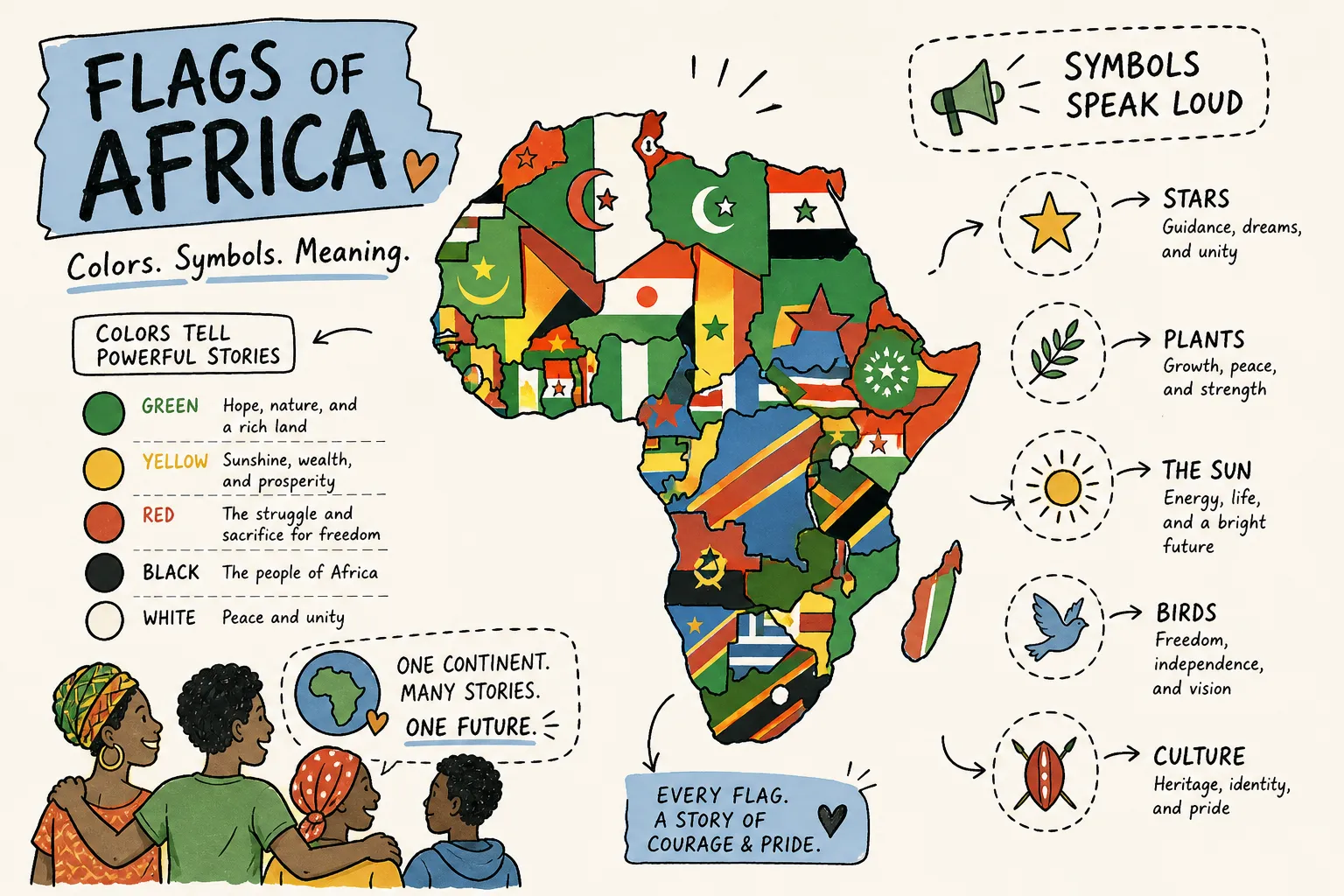
Africa has 54 recognized nations, each with an official national flag, and the flags of Africa are far more learnable than they look. They’re not a chaotic mix of random colors; they follow visual patterns that a focused learner can start recognizing within a single study session. Green, yellow, and red appear together in country after country. Crescents and stars cluster in the north. Shields, birds, and tools show up across the east and south, for example, Kenya’s Maasai shield and spears, Mozambique’s hoe and rifle, and Zimbabwe’s famous Zimbabwe Bird. Once you see those patterns, your brain stops treating each flag as a unique puzzle and starts grouping them into families.
This guide works through Africa’s national flags by color family, regional bloc, and symbol type so you build a real mental framework. You won’t just finish with a list of 54 names; you’ll finish with a system for telling them apart. After the last section, the best next move is to open DodoThinks and run a timed flag challenge to lock in what you learned. Reading builds familiarity. A 9-second-countdown quiz builds memory.
Why color tells you so much on African flags
Here’s the interpretive key: once you understand what the most common colors signal, you can make educated guesses about any flag from Africa before you even know the country’s name. Color is not decoration on these flags. It’s a statement, and most of those statements trace back to a single historical source.
The Pan-African color system and where it started
Ethiopia remained outside sustained European colonial rule and, after defeating Italy at the Battle of Adwa in 1896, became a powerful symbol of African sovereignty. (Italy did occupy Ethiopia briefly from 1936 to 1941, but that occupation never broke the country’s status as an emblem of African independence.) Its green, yellow, and red horizontal stripes became the template that independence-era nations across the continent deliberately borrowed as a declaration: we are free, we are African, and our colors say so. These hues are commonly interpreted as follows, red for the blood shed in liberation struggles, green for the land and agriculture that sustain African communities, and gold (or yellow) for mineral wealth and the brilliance of the sun, though the official meanings vary by country.
That Ethiopian influence is why today 17 African countries officially use the Pan-African color set in their national flags, including Ghana, Senegal, Mali, Burkina Faso, Cameroon, Kenya, and South Sudan. When you spot red, green, and gold on a flag of an African country, your first assumption should be: this country is making a deliberate statement about African identity and independence.
What other colors mean across the continent
Beyond the Pan-African trio, black represents the African people or the continent’s heritage. White signals peace and honesty. Blue represents rivers, sky, and coastal waters depending on the country. In North Africa, the crescent-and-star motif appears repeatedly as a marker of Islamic identity, anchoring a completely different visual tradition from the green-yellow-red palette of sub-Saharan flags. These are widely accepted interpretations that give you a strong foundation before you dive into individual flags.
Flags of Africa: the Pan-African palette
The Pan-African color family is one of the largest visual groups among the flags of Africa and the one most likely to cause confusion. The goal here is pattern recognition: learn the shared vocabulary, then focus on the one or two details that separate near-identical designs.
The classic green-yellow-red vertical tricolors
Three West African flags form the most easily confused cluster on the entire continent. Guinea runs red-yellow-green from left to right. Mali runs green-yellow-red, the reverse of Guinea. Senegal uses the same green-yellow-red order as Mali but adds a single green star centered on the yellow stripe. The color order is your primary anchor; the star on Senegal is your backup confirmation. Drilling those two facts into memory is enough to score correctly on every timed quiz that throws these flags at you.
Stars, discs, and extras that separate similar flags
Burkina Faso uses red over green horizontal bands with a yellow star centered between them. Cameroon runs green-red-yellow vertical stripes with a yellow star on the red center band. Ghana uses horizontal red-gold-green stripes with a black star on the gold band. Notice the differences? Cameroon is vertical; Ghana is horizontal. Ghana’s star is black; Burkina Faso’s is yellow. The distinguishing details are star color, star placement, and stripe orientation. Get those one-second visual anchors right and these flags stop blurring together.
The broader Pan-African family across East and Central Africa
Kenya, South Sudan, Malawi, Angola, and Mozambique all speak the same color vocabulary but rearrange it with added symbols and diagonal stripes. Kenya overlays a Maasai shield and crossed spears on black-red-green horizontal stripes. South Sudan adds a blue triangle at the hoist with a gold star. Mozambique places a yellow star, open book, hoe, and rifle inside a red triangle. These flags reward a second look; the color family gets you in the right neighborhood, and the central emblem seals the identification.
Flags of Africa: regional patterns that speed up recognition
Think of regional clusters as a geographic shortcut. If you know which part of the continent a country sits in, you can narrow down a flag’s identity before you even look closely at the design. This is the same mental move you’d use on a flag map of Africa: location narrows the field, then detail closes the gap.
North Africa: crescents, stars, and Islamic symbolism
Many North African flags feature Islamic symbols, crescents and stars, and several use red prominently, though not all have solid red backgrounds. Algeria splits green and white vertically with a red crescent and star centered on the dividing line. Tunisia uses a red field with a white disc containing a red crescent and star. Libya adds a white crescent and star to a red-black-green horizontal design. Morocco stands out: a solid red field with a green pentagram star and no crescent at all. Mauritania, meanwhile, is green with a gold crescent and star, no red field at all. Spotting those outliers is a useful exercise because it teaches you to look for exceptions within clusters rather than assuming every rule applies universally.
East Africa: shields, animals, and diagonal stripes
East African flags tend to feel more illustrative than the clean geometric stripe designs of West Africa. Kenya’s Maasai shield and spears officially represent the defense of freedom. Tanzania runs a diagonal black band edged in yellow from lower hoist to upper fly, splitting green and blue fields cleanly. Uganda repeats black-yellow-red horizontal stripes three times and centers a grey crowned crane inside a white disc. These flags are more complex visually, which makes them high-value recognition targets once you’ve practiced them a few times.
Southern Africa: the continent’s most geometrically complex designs
South Africa’s flag earns a special mention: a green Y-shape bisects a black triangle at the hoist and fans out into red and blue panels with white and yellow borders. It is one of the most geometrically complex national flags in the world and nearly impossible to confuse with anything else once you’ve seen it. Namibia splits diagonally into blue and green halves with a red stripe and a gold sun symbol. Zimbabwe layers green-gold-red-black horizontal stripes with a white triangle containing a red star and the Zimbabwe Bird. These southern flags reward close inspection and show up regularly in higher difficulty tiers on geography quiz platforms.
The flags that are hardest to tell apart
Even experienced geography fans stumble on these pairs. Knowing the exact distinguishing detail for each one means you stop losing points on questions that should be answerable.
Mali, Guinea, and Senegal: the vertical tricolor trap
Guinea is red-yellow-green. Mali is green-yellow-red (the reverse). Senegal is green-yellow-red with a green star on the yellow stripe. Read the color order left to right and check for the star. That two-step process resolves all three flags every time, even under a 9-second countdown.
Chad and Romania: the flag pair that crosses continents
Chad’s blue-yellow-red vertical tricolor is nearly pixel-identical to Romania’s flag. The only official visual difference is the shade of blue: Chad’s is slightly darker, Romania’s is lighter. No formal bilateral agreement has changed either flag. This is one of the most famous lookalike pairs in world vexillology, and the only reliable fix is memorizing that slight blue difference or using a process-of-elimination approach based on context clues in the quiz.
Guinea-Bissau and its neighbors
Guinea-Bissau uses a red vertical band at the hoist with horizontal yellow-over-green bands on the fly side and a black star on the red stripe. The Republic of the Congo uses a diagonal green band separating yellow and red fields. Both involve the Pan-African palette rearranged into non-standard layouts, which is what makes them trip people up. One anchor per flag is all you need: for Guinea-Bissau, it’s the black star on the left red band; for the Republic of the Congo, it’s the diagonal stripe cutting corner to corner.
Where to find free, high-resolution African flag images
If you want to print a classroom reference or download images for a project, several free sources cover all 54 African national flags at high resolution. Flagpedia offers a free download package of all 254 country flags in PNG, WebP, or JPEG formats and explicitly allows commercial and non-commercial use. CountryFlags.com lets you download editable vector files in EPS, SVG, and PDF formats at no cost, which is the better option if you need clean print results. FreePrintableFlags and Vecteezy are also solid free options for individual country flags.
One practical note for classroom use: a single Africa map with all 54 flags embedded tends to be too small to read at standard print sizes. A better setup is a labeled geography map paired with a separate two-page flag reference sheet. Students can move between the two and build the spatial-visual connection that makes flags stick. Blank map PDFs with country labels are widely available through educational resource sites and work well alongside a printed flag chart.
Put your African flag knowledge to the test right now
Reading a guide like this one builds recognition. A timed quiz is what moves that recognition into long-term memory. Cognitive science has known this for decades: active recall, retrieving information under pressure instead of re-reading, beats passive review every time. Psychologists call it the testing effect, documented in landmark research by Roediger and Karpicke, and it consistently produces more durable knowledge than re-reading the same material.
Why a 9-second clock changes everything
A short response window forces real pattern recognition. Imagine Kenya’s flag flashes on screen and the clock is already ticking, you can’t slowly eliminate options one by one; you have to see the shield and spears and know. That pressure is exactly what trains the visual memory pathways you need to actually recall flags of African countries in conversation, on a test, or during a trivia night. The discomfort of the countdown is the mechanism that makes the knowledge stick.
How DodoThinks flag challenges cover African nations
DodoThinks is built precisely for this moment. The Guess the Flag game mode, effectively an African flag quiz that spans all world nations, tests players on all 54 African countries across three difficulty tiers. Easy mode starts with the most widely recognized flags. Difficult introduces less familiar designs, throwing the rarest and most easily confused flags at you under a tight countdown. Daily challenges, a global leaderboard, and streak incentives give you a reason to come back tomorrow and the day after. Sessions are designed to be fast: a full round takes just a couple of minutes, so you can get genuine practice even on a busy day.
What you now know and where to go next
You started this article with 54 flags that might have felt like an undifferentiated mass of colors. You’re finishing it with three organizing lenses: color families anchored in Pan-African history, regional clusters that narrow identification by geography, and symbol types that close the gap when stripes alone aren’t enough. Work through this framework in a focused session and you’ll be surprised how many flags of African countries you can identify, something most people assume takes months to learn.
The flags of Africa are learnable, and this flags of Africa guide is the fastest path into them. But framework knowledge without practice decays quickly. The best move right now is to take everything you just read straight into a live African flag quiz on DodoThinks, where flags of African nations appear across all three difficulty tiers and the clock keeps you honest. Your first score is your baseline. Your second will be better.