The South African Flag: Colors, Meaning & History Explained
July 18, 2026
If you’ve ever spotted the South African national flag in a quiz or geography class and found yourself wondering what that bold Y-shape is actually doing there, you’re not alone. The flags of South Africa have a layered, complicated history, and the current design is one of the most visually striking in the world, with almost every element tied to a specific story.
Six colors, a converging Y-shape, and a country that redesigned its most powerful national symbol in under a week. This article breaks down what the flag means, where it came from, and why it looks nothing like most other African flags.
By the end, you’ll know the full story — and if you want to test how well you can recognize it under pressure, we’ll point you toward a free way to do exactly that.
The 1994 moment that changed the flags of South Africa forever
South Africa’s first democratic election was scheduled for April 27, 1994, and the country still had no agreed-upon national flag. The old orange-white-blue tricolor, known as the Oranje-Blanje-Blou, carried too much historical baggage: for millions of Black South Africans, it was the flag of apartheid, not of the nation. The ANC’s own black-green-gold flag was equally unacceptable to many white South Africans, making any single-movement design a political impossibility.
Negotiators Cyril Ramaphosa and Roelf Meyer handed the problem to Frederick “Fred” Brownell, the State Herald of South Africa. Brownell had sketched the core concept as early as August 1993, reportedly on the back of a meeting programme while attending a flag conference in Zurich, Switzerland — a detail recounted in accounts of his design process and later referenced in vexillological histories. When the deadline pressure arrived, he refined and finalized the design in roughly one week.
The flag was officially authorized on April 20, 1994, under Proclamation No. 70 of 1994 (Government Gazette No. 15663), and first hoisted on April 27, election day. What was originally planned as a five-year interim solution was confirmed by Parliament as the permanent national flag in 1996, largely because the public had already embraced it completely.
Brownell also designed Namibia’s flag in 1990 and passed away in 2019. Vexillologists and flag historians have described him as someone who captured the spirit of two nations’ hard-won freedom in a single design.
What the six colors actually represent
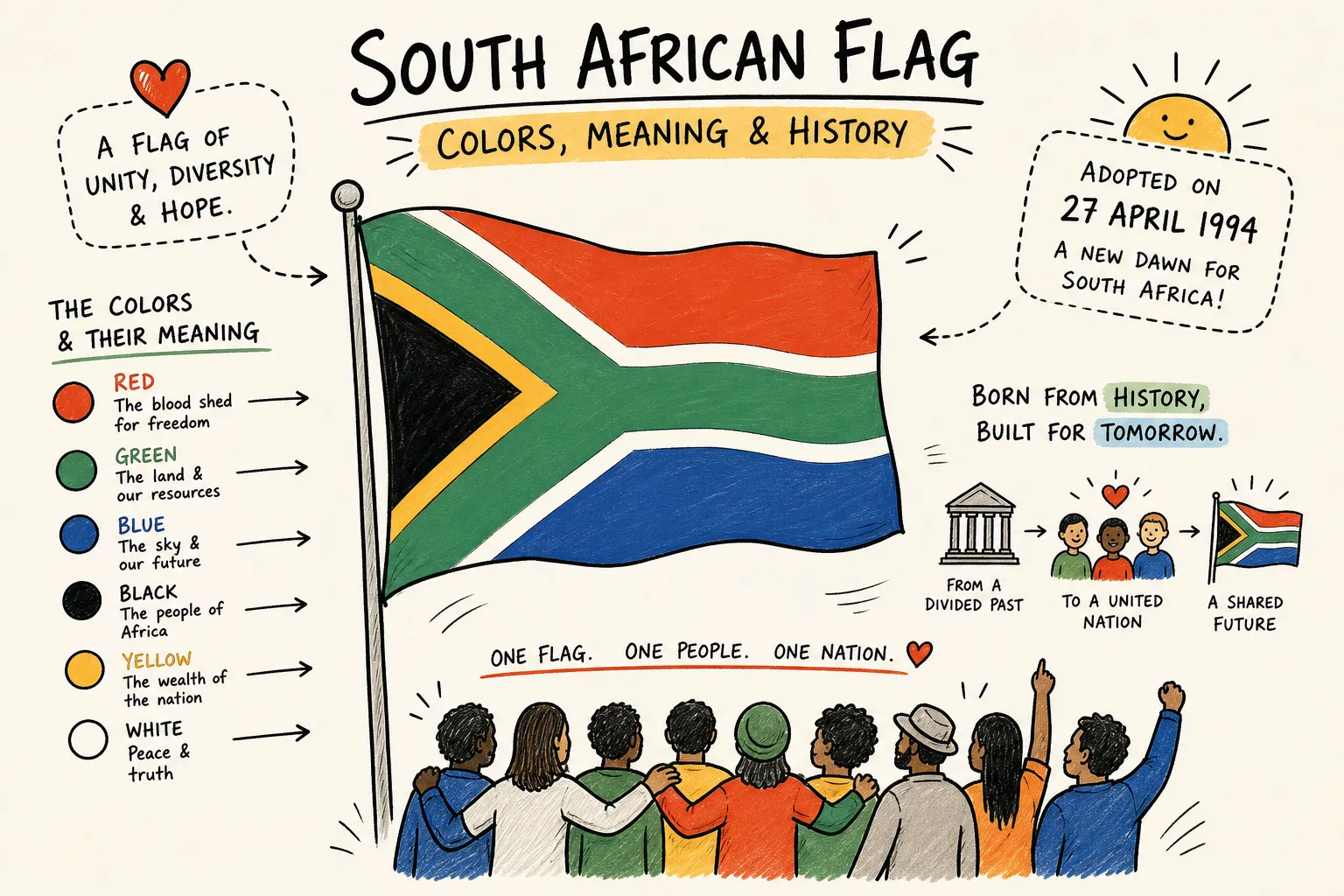
Here’s the answer most people search for, with a twist: the South African government officially states that no universal symbolism should be attached to any single color. The flag is described as a “synopsis” of the country’s flag history rather than a coded message. That’s a deliberate political choice, designed to prevent the flag from becoming the property of any one group. Still, the historical origins of the colors tell a rich story on their own.
Black, green, and gold: the liberation palette
These three colors come directly from the ANC flag, the most prominent liberation movement in South African history. Black represents the people of the land, green represents the fertility of the soil, and gold represents the country’s mineral wealth and natural resources. Together, they carry the weight of the anti-apartheid struggle and the long push for a free South Africa — though the government is careful to note these are common interpretations, not official mandates.
Red, white, and blue: the colonial echo
These colors nod to the British Union Jack and the Dutch-derived Boer republic flags that shaped the country’s colonial era. Red is commonly linked to bloodshed and sacrifice; white to peace between communities; blue to the sky, the oceans, and the idea of open possibility. Their presence in the design signals inclusion rather than erasure. The flags of South Africa, across their history, were built from these same ingredients, and the current flag acknowledges that full complexity instead of pretending it didn’t happen.
The six colors together represent unity. This isn’t about sorting people into “your color vs. mine” — it’s about holding every thread of South African history in the same frame. Brownell and the government made a conscious choice to leave the meaning deliberately open, so that every South African could find themselves in the flag without having to fight over what it means. As the government’s own official description puts it, the flag is a synopsis, not a scorecard.
The Y-shape and what it’s actually saying
The Y-shape, called a “pall” in heraldry, is the most distinctive element of the flag. Unlike the colors, the government does assign explicit meaning to this shape. The pall begins as a V at the hoist (the flagpole side), where two separate paths diverge from the top and bottom corners. Those two paths then merge into a single horizontal band moving toward the fly, the free end of the flag.
The official meaning is straightforward: diverse elements of South African society converging into a single, united future. It’s a visual metaphor for the country’s entire political project after apartheid, rendered in geometry. No other national flag uses a pall design quite like this. The Czech Republic, Djibouti, and the Philippines all use Y-shaped field divisions, but none use a pall as a distinct charge the way South Africa does.
The construction reinforces that message. According to the flag’s official specifications (Schedule 1 of the Constitution and Proclamation No. 70 of 1994), the green band is one-fifth the width of the flag, edged in white on the red and blue sides, and separated from the black triangle at the hoist by a gold border. The total pall plus its fimbriation equals exactly one-third of the flag’s width, making the convergence the dominant visual force across the entire design. The black triangle anchors everything at the flagpole, the point where all paths begin.
The flags South Africa carried before 1994
The Oranje-Blanje-Blou flew from May 31, 1928 to April 27, 1994, making it the flag most South Africans alive in 1994 had known their entire lives. It was itself a compromise design, incorporating the Union Jack, the Orange Free State flag, and the Transvaal Vierkleur on its white stripe — an attempt to satisfy both Afrikaner and English-speaking communities. For the majority of South Africans, however, it had become the unmistakable symbol of exclusion and oppression, which is precisely why a clean break was necessary.
Before the unified South African state even existed, the region was shaped by several earlier flag traditions. The Dutch Prinsenvlag, an orange-white-blue triband flown from 1652 to 1795, directly inspired the 1928 flag’s color scheme. The Vierkleur of the South African Republic used a red-white-blue horizontal tricolor with a vertical green band, and that green stripe fed directly into the DNA of the current flag’s pall. From 1910 to 1928, the Union of South Africa used defaced British Red and Blue Ensigns, known as South African ensigns, as its de facto national flags before the first official flag was formally established.
South Africa also maintains a set of provincial flags — nine in total, one for each province, each with its own distinct heraldic design reflecting regional identity. Reading the current flag as a synthesis of these traditions, rather than a rejection of them, is the most accurate way to understand it. Brownell wasn’t erasing history; he was folding it into something new.
How the flags of South Africa stand apart from other African flags
The Pan-African color tradition traces back to Ethiopia, the only African nation to successfully resist European colonization during the late 19th-century Scramble for Africa. After Ethiopia defeated Italy at the Battle of Adwa in 1896, red, gold, and green became symbols of African resistance and sovereignty. Ghana formalized the tradition at independence in 1957, and dozens of newly independent nations followed through the 1960s. The result is a regional palette shared by the flags of Cameroon, Senegal, Guinea, Mali, and many others — which makes quick identification genuinely difficult when you’re staring down a long list of African flags.
South Africa’s design cuts through that visual noise. Where most African flags use three or four colors, South Africa uses six, which creates a deliberately complex image. The Y-shape has no equivalent on any other African national flag. The design also bridges two separate color traditions — the liberation palette and the colonial palette — rather than choosing one over the other. Once you understand the story behind the convergence, you can’t unsee it. You won’t confuse it with any other flag on the continent.
Knowing a flag’s history is a great start, but recognizing it under pressure is a different skill entirely. DodoThinks’ Guess the Flag is a free game where you identify country flags, including all the flags of Africa, with just 9 seconds per question. The timed format builds genuine recall in a way that reading alone never does. Start with the Africa region on the hardest difficulty and see how quickly you can separate South Africa’s six-color pall from the sea of red, gold, and green surrounding it.
What this flag gets right about national symbols
The South African national flag is a compressed history lesson stitched into cloth. The Y-shape, the six colors, and the one-week design sprint in 1994 all tell the story of a country that chose to represent complexity rather than simplify it away. Most national flags reduce: they pick a palette, arrange stripes or symbols, and call it done. This flag does something more ambitious. It holds two traditions in the same frame and uses geometry to argue that they can share a future.
That’s what makes the flags of South Africa, past and present, so rewarding to actually learn. The more you know, the more you see. The black triangle at the hoist is not decorative; it’s the starting point of every path the country has ever taken. The converging green band is not just a design choice; it’s a political argument rendered in cloth.
If you want to lock this knowledge in, head over to DodoThinks and take on the Guess the Flag challenge. It’s free, the countdown keeps you honest, and it covers every country on the planet across three difficulty levels. The flags of Africa are a genuinely tricky category, and South Africa’s is the one that, once you know it, you’ll never get wrong again.