
Pan-African Colors Explained: What They Mean on African Flags
July 6, 2026 · 6 min read
Pan-African colors — red, black, green, and gold — appear on more flags than most people realize, and there's a reason for it. Look at a map of African flags and something jumps out immediately: roughly two dozen of them share some combination of these four colors. It's not a coincidence, and it's not a trend. It's history, written in color.
Two separate origin stories gave rise to what we now call the Pan-African palette, and most people only know half the story. The first traces back to Ethiopia, which defeated the Italian army at the Battle of Adwa in 1896 and preserved its sovereignty while nearly every other African nation fell under colonial rule. The second comes from a convention hall in New York City in 1920, where Marcus Garvey and the Universal Negro Improvement Association raised a flag that would become a global symbol of Black liberation.
By the end of this article you'll know exactly what each color represents, which nations chose these palettes and why, and you'll have precise HEX, RGB, and Pantone values if you need them for a project.
The story behind Pan-African colors
Two distinct origins gave rise to the colors we now associate with Pan-African identity, and conflating them causes real confusion.
Ethiopia's defiance and how it became a symbol
On March 1, 1896, Ethiopian forces under Emperor Menelik II defeated the Italian army at the Battle of Adwa — a landmark victory that preserved Ethiopian sovereignty. Ethiopia remained free while nearly every other African nation fell under colonial rule. That fact was electric to newly independent African states in the 1950s and 1960s. When they designed their own flags, many borrowed Ethiopia's green, yellow, and red as a direct statement: we stand where Ethiopia stood.
Marcus Garvey's UNIA flag and the 1920 convention
On August 13, 1920, at Madison Square Garden, the UNIA held its First International Convention. In the Declaration of the Rights of the Negro Peoples of the World, it formally declared red, black, and green the official colors. Garvey's reasoning was simple: every recognized group of people had a flag, and Black people needed one too — "Show me the race or the nation without a flag, and I will show you a race of people without any pride." The UNIA palette was distinct from Ethiopia's flag, though both traditions eventually merged into the broader Pan-African color identity recognized today.
What red, black, green, and gold actually mean
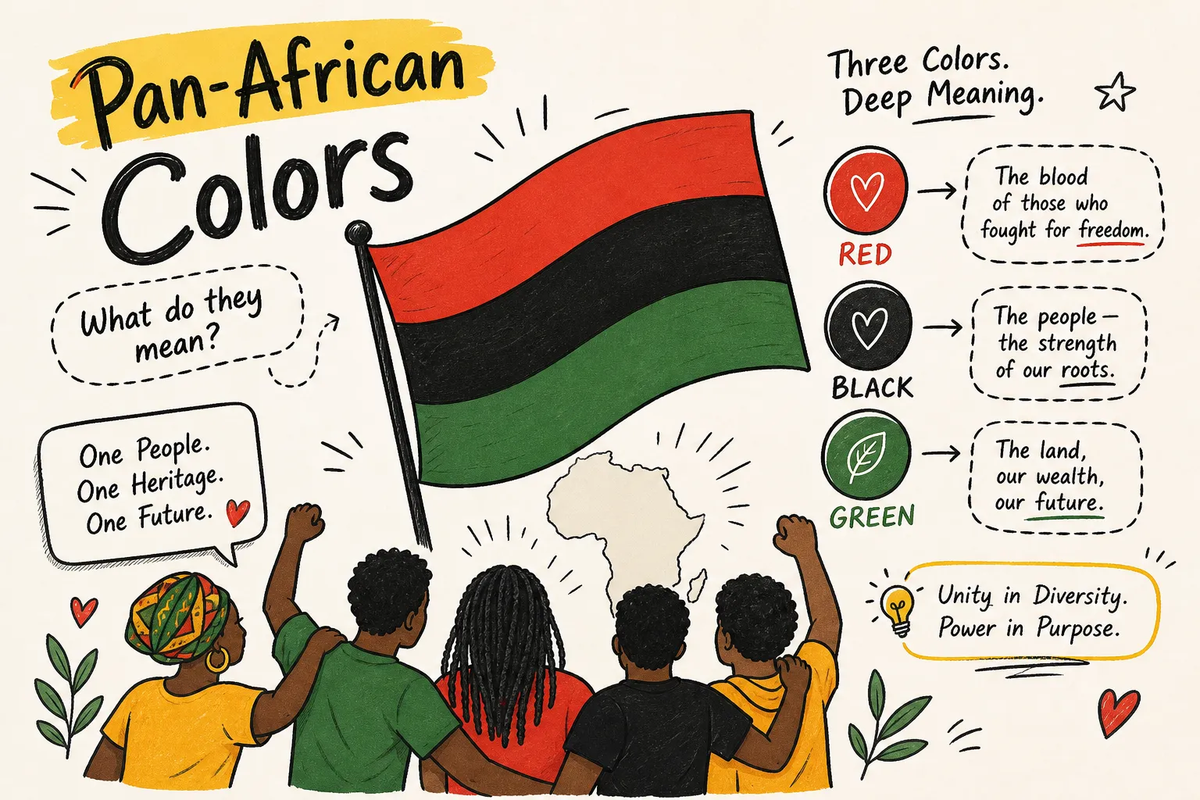
These colors aren't decorative choices. The UNIA's declarations and generations of Pan-Africanist thought assigned each a specific meaning.
Red and black: sacrifice and identity
Red represents the blood shed for liberation — the sacrifices of African ancestors who fought oppression and colonization; the UNIA defined it as "the noble blood that unites all people of African ancestry." Black represents the people themselves: collective identity, pride, and a unified people across national borders. Together they declare: this is who we are, and this is what we paid.
Green and gold: land, wealth, and the future
Green stands for Africa's fertile land, natural resources, and mineral wealth — the UNIA's "rich land of Africa." Gold (or yellow) carries the future: the belief that justice will prevail and the sacrifices represented by red were not made in vain. Gold also connects to African mineral wealth and to the symbolism Ghana embedded in its 1957 flag, the first sub-Saharan African nation to gain independence.
Two palettes, one shared identity
Many readers don't realize there are two distinct Pan-African palettes, not one.
The Garvey palette (red, black, green)
The original flag adopted at the 1920 convention. It's associated with Black nationalism, African diaspora movements, and liberation organizations including the Black Panther Party. Vexillological convention reserves the term "Pan-African flag" specifically for this red-black-green combination. Fewer current national flags use this strict trio, but its influence on diaspora movements is enormous.
The Ethiopian palette (red, gold, green)
Derived from Ethiopia's flag, this combination spread rapidly across newly independent African states. Ghana's 1957 flag became the template — its red-gold-green tricolor with a black star showed the world what post-colonial African identity looked like, and many nations followed. As of 2026, 17 African national flags incorporate this red-gold-green palette. The four-color version (red, black, green, and gold) blends both traditions into the palette most commonly associated with Pan-African identity today.
Pan-African colors on national flags
As of 2026, 17 African national flags incorporate the red-gold-green palette, including Ghana, Guinea, Senegal, Mali, Burkina Faso, Cameroon, Kenya, and Togo. Ghana's — horizontal red-gold-green with a central black star — is the most recognized. Guinea uses a vertical red-yellow-green tricolor; Senegal reverses that to green-yellow-red and adds a central green star.
Kenya adds a twist: black, red, and green separated by thin white stripes, with a Maasai shield at the center — bridging both palettes (black from Garvey; red and green from Ethiopia). Mozambique and post-apartheid South Africa both contain red, black, green, and gold, genuinely blending both traditions. At the movement level, the UNIA and the Black Panther Party flew the strict red-black-green.
Exact color codes for both palettes
These are standardized palette values, not any single country's official government spec — national flags adapt them slightly. Treat them as your baseline for design work and always verify a country's official specs when precision matters.
Garvey / UNIA palette (red, black, green)
| Color | HEX | RGB | Pantone |
|---|---|---|---|
| Red | #E31B23 |
227, 27, 35 | 485 C |
| Black | #000000 |
0, 0, 0 | Black 6 C |
| Green | #12853F |
18, 133, 63 | 348 C |
Ethiopian / West African palette (green, gold, red)
| Color | HEX | RGB | Pantone |
|---|---|---|---|
| Green | #078930 |
7, 137, 48 | 3425 C |
| Gold | #FDE642 |
253, 230, 66 | 7408 C |
| Red | #DA121A |
218, 18, 26 | 179 C |
Notice the differences: the Garvey red is brighter (#E31B23, Pantone 485 C) while the Ethiopian red runs slightly deeper (#DA121A, Pantone 179 C). The greens diverge too — the Garvey green is darker (#12853F), the Ethiopian green brighter and more saturated (#078930).
Think you can recognize these flags under pressure?
Reading about these palettes is genuinely useful. But here's the honest challenge: Guinea, Senegal, and Mali all use vertical red-yellow-green or green-yellow-red tricolors. They look nearly identical at a glance, and knowing the theory doesn't mean you can tell them apart when a flag flashes on screen for nine seconds.
Why recognition beats reading
Passive reading and active recall are two different skills. You can memorize that Guinea uses red-yellow-green and Senegal uses green-yellow-red and still freeze when you actually see them. The only way to build real flag recognition is repeated, timed practice where your brain has to retrieve the answer rather than read it.
How DodoThinks builds that recognition
DodoThinks' Guess the Flag is built around this exact challenge: each round shows a flag and gives you nine seconds to identify the country. The timed format forces genuine recall. Three difficulty tiers let you start with the most recognizable African flags, then work up to the harder levels where near-identical flags really test you. It's free, and it turns everything you just read into a skill you can demonstrate.
History you can play with
The two Pan-African palettes trace back to two acts of defiance separated by 24 years and an ocean: Ethiopia's green-gold-red after Adwa in 1896, and Marcus Garvey's red-black-green after the UNIA convention in 1920. The core meanings are worth committing to memory: red is sacrifice, black is the people, green is the land, and gold is the future.
Now you have the context, the symbolism, and the exact values. Head to DodoThinks and run through Guess the Flag — see how quickly you can place Guinea against Senegal, or Ethiopia against Benin, before the timer runs out.