Guess the Flag Games: How They Work and Tips to Win
July 7, 2026 · 6 min read
You're staring at a red, white, and blue tricolor. The timer hits five seconds. Is it France or the Netherlands? Your brain scrambles. Four. You click. Wrong.
That split-second failure is exactly what makes a guess-the-flag game so addictive — and so effective. The mix of speed, visual pattern recognition, and geography knowledge hits differently than any flashcard app or textbook map ever could. The pressure of a countdown forces your brain to retrieve answers rather than puzzle them out slowly — a fundamentally more powerful way to learn.
DodoThinks was built around this mechanic: a free platform where every round gives you nine seconds per question and ten flags per session to test what you actually know, not what you think you know. This guide breaks down how these games work, why the timed format accelerates learning, and what strategies will raise your score fast.
How a guess-the-flag game actually works
The basic round format
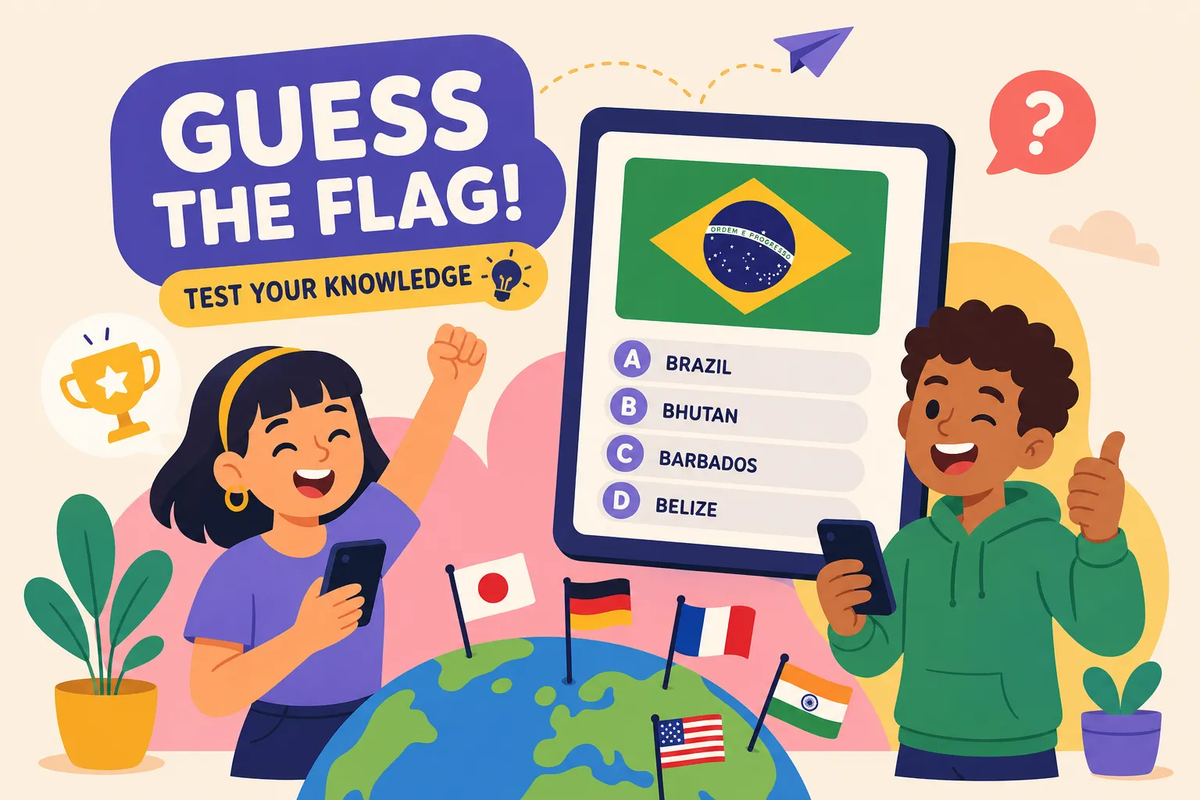
A standard session is straightforward: a flag appears, a nine-second timer counts down, and you pick from options or type the country name. Many platforms run 10-question rounds, so a full session takes under two minutes.
The two input styles create very different experiences. Multiple-choice builds hints into the options, which makes it easier — but lets your brain use process of elimination rather than genuine recall. Type-to-answer is harder because it demands full retrieval with no scaffolding. If you want to truly memorize flags rather than just recognize them in a lineup, type-to-answer produces stronger learning. Either way, the timer is the real mechanic: it pushes you toward pattern recognition rather than slow logical reasoning.
Game modes that go beyond basic identification
Flag identification is the entry point, but the best platforms expand well beyond it — guessing a capital from a flag, identifying which countries share a border, deciding whether a country is landlocked, or working in reverse from a capital to its flag. Each mode targets a different layer of geography knowledge and reinforces the others.
This variety matters: repeating a single format creates a knowledge ceiling. DodoThinks addresses this with nine distinct game modes covering flags, shapes, capitals, borders, languages, landlocked status, and more — a geography curriculum that stays fresh across hundreds of sessions.
How difficulty tiers change everything
At the easy level you're seeing the US, France, Brazil, and Japan. At the hardest tier you're facing Eswatini, Nauru, and Comoros — less familiar countries whose flags can look remarkably similar to their neighbors. Difficulty tiers let beginners build speed and confidence before hitting flags that share a color family or differ by a single emblem. DodoThinks uses three tiers — Easy, Difficult, and So Difficult — designed as a progressive curriculum. The progression keeps you working at the edge of what you know, which is where real learning happens.
Country coverage matters
A game covering only 50 flags will plateau your learning fast. Look for platforms with a broad country set — many cover the 193 UN member states, others extend to 197+ with territories. Equally important is how difficulty scales: good platforms weight harder flags more heavily as you advance, so you're not seeing the US flag constantly and Kiribati almost never.
Why timed flag games are genuinely effective
Active recall beats passive review
Passive study means looking at a flag next to its label. Active recall means seeing the flag first and forcing your brain to retrieve the answer. Retrieval practice strengthens memory far more than re-reading — studies of learning techniques consistently rank practice testing as high-utility and re-reading as low-utility.
A flag game is active recall by design. Every question is a low-stakes test, and every wrong answer signals which flags need more repetition. The quiz is the study session — and it's more efficient than most people expect. One caveat: extremely tight windows can impair encoding under stress. Nine seconds per flag sits in a productive range — enough urgency to engage pattern recognition, not so rushed that it's counterproductive.
Short daily sessions beat long cramming
A 10-round quiz takes roughly 90 seconds — short enough for a coffee break, long enough for multiple retrieval attempts. Players who return daily build a compounding base where each session reinforces yesterday's flags while introducing new ones. Players who binge once and skip four days lose retention. The forgetting curve is real, and consistent short sessions fight it far better than occasional marathons. The world leaderboard adds a live benchmark — your score versus others playing that day — a layer of social motivation self-study rarely provides.
The flags that fool even experienced players
Flags that look nearly identical
Some of the most confusing pairs differ by a single shade or a small emblem. Chad and Romania share nearly identical vertical stripes, separated only by Chad's slightly darker blue. Indonesia and Monaco are both red-over-white bicolors with different proportions. New Zealand and Australia both feature the Union Jack and Southern Cross but swap star counts and colors.
A few more worth committing to memory: Poland has white on top, Indonesia the reverse. Norway is a red field with a blue cross edged in white; Iceland flips that. Bahrain has five serrated triangles along its edge, Qatar has nine and a darker maroon. (For the European look-alikes specifically, see European Flags Quiz.)
Regional pattern families to learn first
Flags cluster into families by shared history. African flags group around Pan-African colors (red, green, black, and gold). Scandinavian flags all use an offset cross on a solid field. Arab countries frequently use green, white, and crescent symbols. South American nations influenced by Gran Colombia use yellow, blue, and red. Learning those families first gives you a powerful triage tool.
Practical tips to raise your score today
Lead with color and layout, not country names
Your brain's fastest path to identification runs through visual structure: color count, arrangement (stripes, field, cross, canton), and symbols (crescent, star, coat of arms). Train yourself to read left-to-right, top-to-bottom. "Three vertical stripes, blue-white-red, no symbol" narrows quickly to France — though always check similar flags like Romania first.
Use the difficulty tiers as a curriculum
Don't jump to the hardest tier immediately. Start on Easy to build speed with flags you half-know. Once you're consistently scoring 8–9 out of 10, move to Difficult. The controlled progression means you meet new flags in manageable batches instead of being overwhelmed by ~200 unknown images at once.
Treat wrong answers as a study list
Every flag you miss is a data point. After a session, note the flags that stumped you, find the country on a map, and read one distinguishing fact. Attaching a specific memory to the flag builds a much stronger retrieval cue for next time.
Play daily, not in occasional marathons
Consistency beats volume in active-recall training. A 10-question daily challenge keeps learned flags active while introducing new ones. Set a streak goal, check the leaderboard each day, and treat the 90-second challenge as a non-negotiable part of your routine.
Put it all into practice
Flag games work because they're built on one of the most reliable learning principles: retrieval practice under manageable time pressure. When you give yourself nine seconds to name a flag, you're not studying — you're testing. Repeated testing, structured by difficulty tiers and reinforced by daily streaks, is how geography knowledge actually sticks.
If you want to put every tip here to work right now, DodoThinks offers a free, no-download guess-the-flag game with nine modes, three difficulty tiers, a 9-second countdown, a global leaderboard, and a daily challenge. One round takes 90 seconds — head over and find out which flags you actually know.