
New Zealand vs Australia Flag: 6 Differences That Matter
July 21, 2026 · 9 min read
The New Zealand vs Australia flag comparison is one of vexillology's great visual traps. Picture this: two blue flags appear side by side on your screen. Both have the Union Jack in the top-left corner. Both have the Southern Cross constellation on the right. You have five seconds to identify which is which. If your stomach just dropped a little, you're not alone. These are arguably the most commonly confused national flags in the world, and the mix-up makes complete sense once you understand their shared history. This article breaks down every meaningful visual difference between the two flags, explains why they ended up looking so similar, and gives you a repeatable mental checklist for instant identification.
The confusion isn't a matter of carelessness. It's a matter of design history. Both nations made deliberate, parallel choices within a year of each other, and the result is two flags that function like visual siblings. Once you know what to look for, the differences are obvious and quick to spot. Until then, they're a genuine trap.
Why these two flags look nearly identical
Both New Zealand and Australia were British colonies, and their flags reflect that political reality directly. The Union Jack occupies the upper-left canton of both flags as a marker of their relationship with Britain and continued Commonwealth membership. The Union Jack itself is a layered design combining the cross of St. George for England (red cross on white), the cross of St. Andrew for Scotland (white diagonal cross on blue), and the cross of St. Patrick for Ireland (red diagonal cross on white), first unified in 1606. When both nations formalized their flags in the early 1900s, keeping the Union Jack was a deliberate signal of constitutional loyalty to the Crown, not an accident of design.
The Southern Cross constellation appears on both flags for a straightforward geographic reason: it's one of the most prominent star patterns visible only from the southern hemisphere. For both nations, it served as a natural symbol of geographic identity, distinguishing them from British territories in the north. Using the same constellation over the same colonial symbol in the same corner, adopted within one year of each other, Australia in 1901, New Zealand in 1902, created two flags that were always going to look like close relatives. That timing sealed the visual overlap from day one.
New Zealand vs Australia flag: star count and the Commonwealth Star
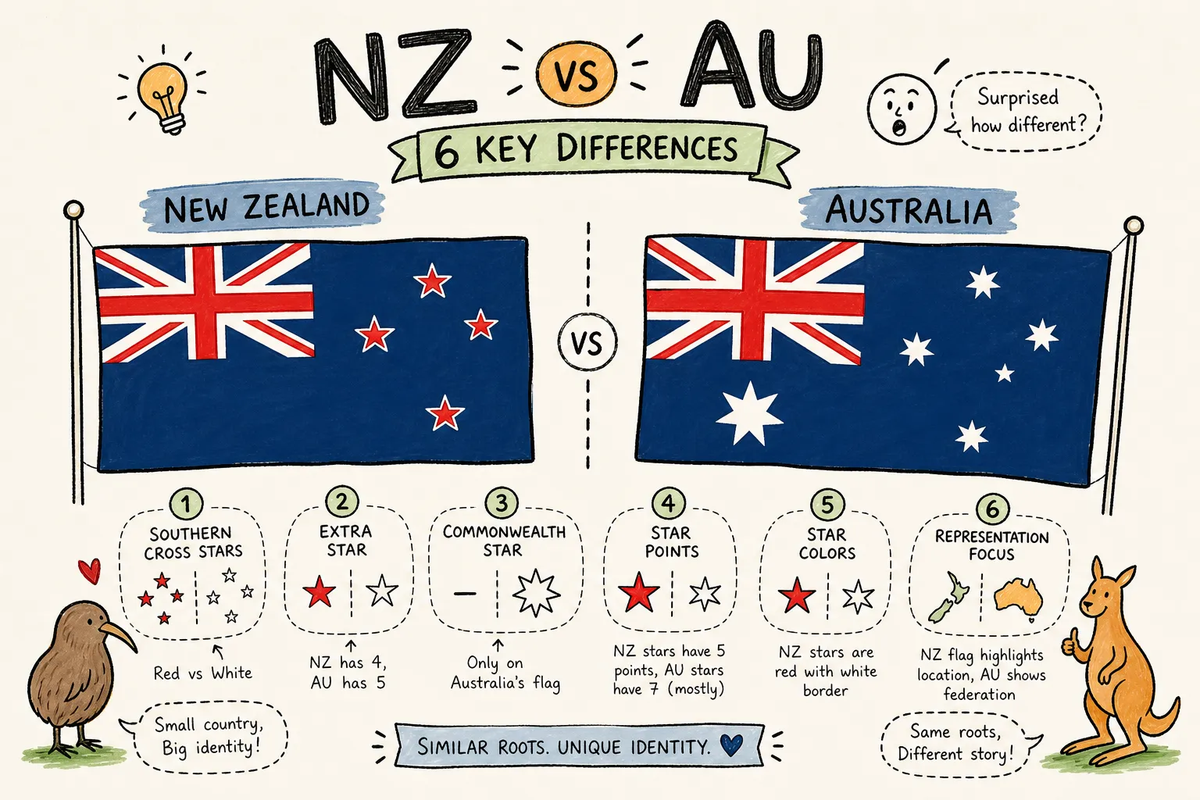
Star count is the single biggest tell in the New Zealand vs Australia flag comparison, and it's the first thing to check under time pressure.
New Zealand's flag shows four stars, all positioned on the right half (the fly side) of the flag. These four stars represent the brightest stars in the Southern Cross constellation, with no additional star anywhere on the flag. If you count four stars and nothing beneath the Union Jack, you're looking at New Zealand, full stop.
Australia's flag shows five Southern Cross stars on the fly side, including a smaller fifth star designated Epsilon Crucis, whose IAU-recognized proper name is Ginan, that New Zealand's design leaves out. But the defining tell is the sixth star: a large, seven-pointed star called the Commonwealth Star positioned directly beneath the Union Jack in the lower-left area of the flag. Six points on this star represent Australia's six original founding states; the seventh point, added in 1908, represents Australia's territories. No other flag in the world uses this exact combination. If you see a star beneath the Union Jack, it's Australia, every single time.
What the Commonwealth Star actually encodes
Australia's Commonwealth Star is the most symbolically precise element across both flags. Each of its six founding-state points represents one of Australia's original states: New South Wales, Victoria, Queensland, South Australia, Western Australia, and Tasmania. The seventh point, added in 1908, represents Australia's territories, including Papua and any future acquisitions. This makes the Commonwealth Star a political document embedded in the flag's geometry. It reflects Australia's federal structure in a way New Zealand's design never attempts to match.
The constellation's smallest star, Ginan, is also the only star on the Australian flag with an officially recognized Australian Aboriginal name, from the Wardaman people, meaning "a red dilly-bag filled with special songs of knowledge."
Star color, star borders, and what they signal
New Zealand's four Southern Cross stars are red with a white outline around each one. Australia's Southern Cross stars are solid white with no outlines at all. This color difference is visible even at a small size and is one of the fastest ways to separate the two flags under quiz pressure. The red color on New Zealand's stars is widely understood to honor Māori culture, where red carries deep significance as a color associated with authority and the sacred, giving the flag a cultural layer that goes beyond colonial design.
Both flags use blue backgrounds, and while the official Pantone specification for both is technically Pantone 280 C (royal blue), New Zealand's background is widely described as a deeper navy in practice, while Australia's reads as a standard, slightly lighter blue. This shade difference is subtle under poor lighting but visible in standard conditions. One thing that won't help you: the Union Jack itself. Its placement, size, and internal proportions are essentially identical on both flags, so staring at the canton alone will leave you stuck. The star details are where you win or lose the identification.
What each symbol actually means
New Zealand's flag carries no single officially codified meaning for each individual star. The four stars collectively represent the Southern Cross and New Zealand's geographic position in the South Pacific. The red color of the stars is widely interpreted as honoring Māori heritage, where red is associated with authority and the sacred, though this symbolism isn't written into law. The flag communicates geographic identity and colonial history, but its symbolic vocabulary stays relatively loose compared to its Australian counterpart.
The Commonwealth Star's symbolism, by contrast, is precise and formally documented. Six of its seven points each represent one of Australia's founding states, while the seventh covers its territories. This makes it a living constitutional record stitched into the fabric of the flag, a specificity New Zealand's design simply doesn't share.
The time New Zealand nearly changed its flag
New Zealand held a two-stage national referendum between 2015 and 2016 to decide whether to replace its 1902 design. In the first stage, voters used a preferential voting system to select a new design from five alternatives. The winner was the Silver Fern (Black, White, and Blue), designed by Kyle Lockwood, an architectural designer from Wellington who first conceived the silver fern concept in 2000. The silver fern is one of New Zealand's most recognized national symbols, and proponents argued it would give the country a flag with a genuinely distinct identity rather than one perpetually confused with Australia's.
In the binding second stage held in March 2016, 56.6% of voters chose to retain the existing 1902 design. The arguments against change were layered: critics felt the process was rushed, dismissed the Silver Fern design as too close to a corporate or sports logo, and argued that altering the flag dishonored the soldiers who fought under it. A significant portion of the opposition vote was also read as a protest against Prime Minister John Key, who had championed the referendum. The process cost an estimated NZ$26 million in total. Australia has never held a national referendum on its flag, though debate about removing the Union Jack surfaces periodically in public life. For now, both flags remain unchanged.
How to train your brain for split-second flag calls
Reading about the differences between these two flags and actually recognizing them under pressure are two completely different skills. Most people can distinguish the New Zealand and Australian flags when given time to study both side by side. The real test is recognition in under ten seconds, the kind of snap identification that separates confident answers from lucky guesses at trivia night or in a geography exam. Passive reading builds familiarity but doesn't build the fast-recall reflex that makes the distinction automatic.
Active recall under timed pressure is what converts knowledge into instinct. Roediger and Karpicke's 2006 research on the testing effect demonstrated that effortful retrieval strengthens memory far more effectively than passive review, an effect especially pronounced for visually similar symbols where the brain needs to differentiate overlapping patterns. The timer is the tool. When you're forced to retrieve the answer before the clock runs out, your brain attaches meaning and urgency to the visual details in a way that rereading simply doesn't trigger.
DodoThinks' Guess the Flag mode puts you in exactly this scenario. Each round gives you nine seconds per question, long enough to think, short enough to punish hesitation. When the New Zealand and Australian flags appear in rotation, players learn very quickly that counting stars or spotting the Commonwealth Star has to happen in a single focused glance. That pressure converts the visual checklist from something you know intellectually into something your brain retrieves on instinct. A few focused sessions on DodoThinks after reading this article is the most efficient way to make these differences genuinely stick.
Your six-point visual checklist
Here's the mental shortcut you can apply immediately, whether you're sitting a geography exam, competing at pub trivia, or running through a daily challenge on DodoThinks:
- Check beneath the Union Jack. A star there means Australia. No star means New Zealand.
- Count the fly-side stars. Four stars: New Zealand. Five stars: Australia.
- Check star color and borders. Red stars with white outlines: New Zealand. Solid white stars: Australia.
- Check the star points. All five-pointed stars: New Zealand. One seven-pointed Commonwealth Star plus four five-pointed Southern Cross stars: Australia.
- Note the background shade. Deeper navy blue: New Zealand. Standard blue: Australia.
- Remember the referendum. New Zealand tried to change its flag in 2016; Australia never has. That history reflects how distinct their national conversations about identity have been, even when the flags looked nearly the same.
The flags are learnable, and the history makes them memorable
The New Zealand vs Australia flag confusion is one of the most understandable mix-ups in all of vexillology. Both nations shared colonial origins, both adopted the Union Jack and the Southern Cross within a year of each other, and both ended up with blue designs that function as visual siblings. But the differences are real, specific, and entirely learnable: four red-outlined stars versus six stars including a white Commonwealth Star beneath the Union Jack, deeper navy versus standard blue, and stars with white outlines versus solid white stars.
Add the historical context of New Zealand's 2016 referendum, Australia's unchanged federal symbolism embedded in the Commonwealth Star, and the cultural weight of Māori red on New Zealand's design, and you have a comparison that's genuinely worth knowing. It's not just trivia. It's a compact lesson in how nations encode identity, history, and politics into a rectangle of fabric. With this checklist in hand, the New Zealand vs Australia flag distinction becomes instant and reliable.
Put the visual checklist to work in DodoThinks' timed Guess the Flag mode, and you'll move from knowing the differences to owning them. That's the gap between reading and real geography fluency, and closing it takes about fifteen minutes of focused play.