
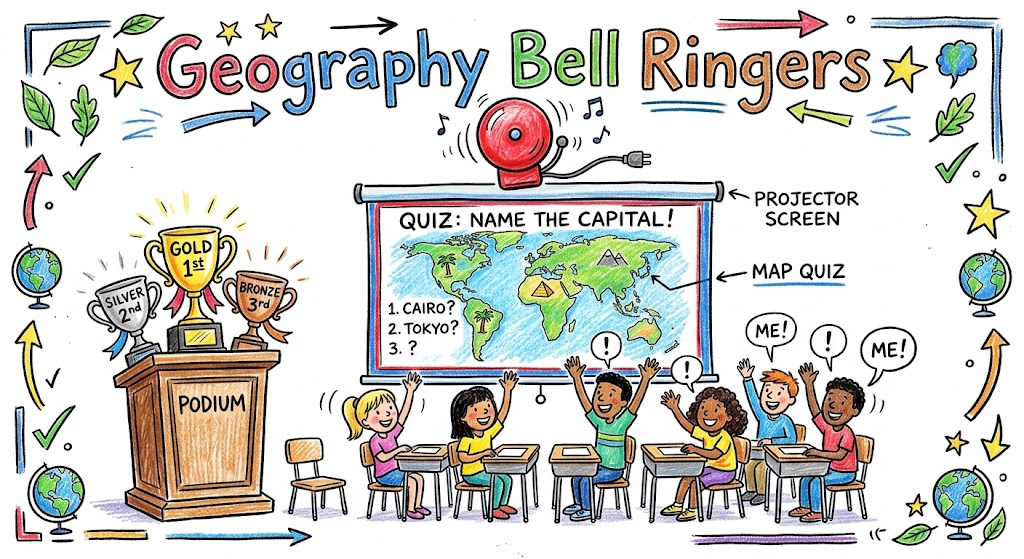
Geography Bell Ringers: 10 Quick Map Activities for Class
October 27, 2026 · 4 min read
A bell ringer is the short task waiting for students when they walk in: five to ten minutes that settles the class and gets everyone thinking before the lesson starts. Geography is a great fit, because a map or flag question takes seconds to read and the whole room can answer at once.
Here are ten bell ringers built on free games from DodoThinks. Students need no account and no email, and every one of them works on a projector, an interactive whiteboard or student phones.
Quick picks:
| If you have | Try |
|---|---|
| Five minutes and a projector | 1. Flag of the day |
| Ten minutes and student devices | 4. The class challenge |
| No devices at all | 9. Blank map relay |
| A US geography or civics unit | 6. Region of the week |
1. Flag of the day
Open the Daily Flag on the projector. It is a mystery flag uncovered tile by tile, with a new one every day. Students write down a guess each time a new tile appears, and the class sees who got it earliest. Over a term, that is a lot of flags without a single worksheet.
2. Name that shape
Country Shapes shows only a country's outline. Show one, give the class twenty seconds, and ask for the continent first, then the country. Naming the continent is a fair first step for younger classes, and it gets everyone talking about where the shape could be.
3. One map, ten questions
Pick the map quiz that matches your unit, such as the Europe map, the Africa map or the South America map, and play one round together. A place is named, students write or call out where it is, and one volunteer clicks. Ten questions is about the right length for a warm-up.
4. The class challenge
This one turns the warm-up into a competition. On the class challenge page, pick a game and a round, and you get a 6 letter code and a QR code. Students type a first name and play the same ten questions on their own phone, tablet or Chromebook.
Their scores arrive on a live board that you can put on the projector, with gold, silver and bronze trophies for the top three and the class average at the top. Each student gets one try, so it doubles as a quick check of what the class already knows.
5. Capital or not?
Say a famous city and ask the class: is it the capital? Sydney (no, Canberra), Toronto (no, Ottawa), Istanbul (no, Ankara), Zurich (no, Bern), Auckland (no, Wellington). Then play a round of Capital City to check.
These traps are real: in our data, New Zealand and Switzerland are among the capitals people miss most, because the best-known city is not the capital. Our post on the capital cities people get wrong has the full list.
6. Region of the week
For US classes, take one of the five regions taught in US schools each week. On Monday, find the states with the region's quiz; midweek, play its capitals round; on Friday, mix the two. Start with the Northeast, then the Southeast, Midwest, Southwest and West. After five weeks the class has worked through all 50 states, and the US regions page puts them back together.
7. Which continent?
For younger students, Which Continent asks only one thing: which continent does this country belong to? It is a gentle way to build the big picture before anyone has to find a country on a blank map.
8. Spot the difference
Put two flags that look alike side by side and ask what is different. Good pairs are the Netherlands and Luxembourg, Chad and Romania, and Costa Rica and Thailand. Then play a round of Guess the Flag. Our post on the flags people confuse most has more pairs, and the reasons people mix them up.
9. Blank map relay
No devices needed. Print a blank map for each group: the world, a continent or a country. Call out a place, and the groups race to label it. The first group with the right answer gets the point. Keep a labeled copy for yourself to check the answers.
10. Beat the computer
Invite two students to the board for the 1v1 Flag Game. They race the computer, or each other, through the same ten flags while the class cheers. It takes only a couple of minutes and makes a good reward on a Friday.
Tips that make bell ringers work
- Same time, every day. Have the warm-up on the screen before the bell, so students know what to do the moment they sit down.
- Keep it short. One round of ten questions is enough. Stop while it is still fun.
- Track the class, not the student. Write the class average on the board on Monday and try to beat it by Friday. The class challenge board shows the average for you.
- Mix the formats. Projector one day, devices the next, paper on the third. Different formats keep the routine from going stale.
What students share
Very little, on purpose. In a class challenge, a student types only a first name or a nickname. There is no account and no email, class rounds show no ads, and a challenge and its results are deleted 30 days after it closes. You can also take any name off the board yourself.
Used in classrooms
Since class challenges started in mid October 2026, schools in nine countries have used them: Egypt, Algeria, Tunisia, Romania, India, Colombia, the Dominican Republic, Canada and the United States. If you try one of these bell ringers with your class, we would love to hear how it went: tell us here.